
Mat3ra is leading AlphaFilm, a DOE Genesis Mission project to accelerate thin-film materials discovery by up to 30x using closed-loop, agentic AI — in partnership with National Lab of the Rockies and the University of Tennessee, Knoxville.

Mat3ra is leading AlphaFilm: Closed-Loop Agentic AI for Thin-Film Materials, one of over 300 Phase 1 projects selected this year under the U.S. Department of Energy's Genesis Mission, announced this past July.
Thin films used in semiconductor manufacturing are difficult to develop. Unlike areas of materials discovery that lend themselves to pure simulation, thin films are full of real-world defects and irregularities that have to be scanned, analyzed, and modeled before a winning recipe is found. With AlphaFilm, we're aiming to compress that cycle — from what today can take weeks or months down to days or hours.
Our focus is on ferroelectric wurtzite nitride thin films, including aluminum scandium nitride and alloyed aluminum nitride — materials that could underpin a new generation of semiconductors for non-volatile memory, RF filters, neuromorphic computing, and sensors for jet engines and spacecraft.
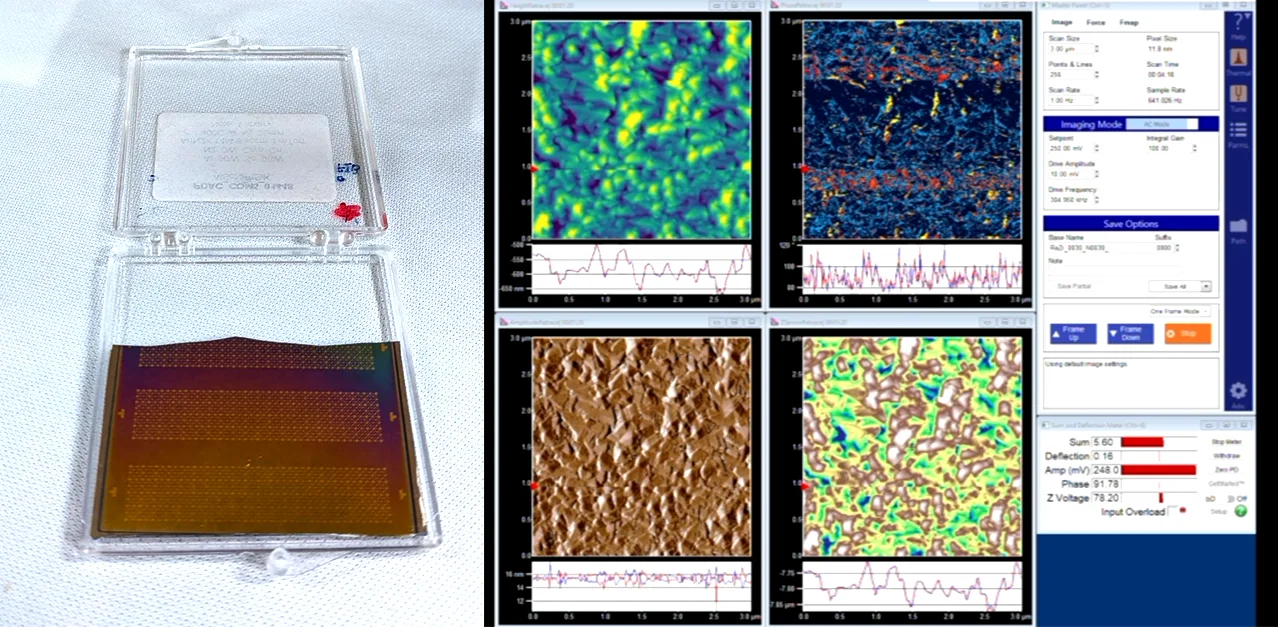
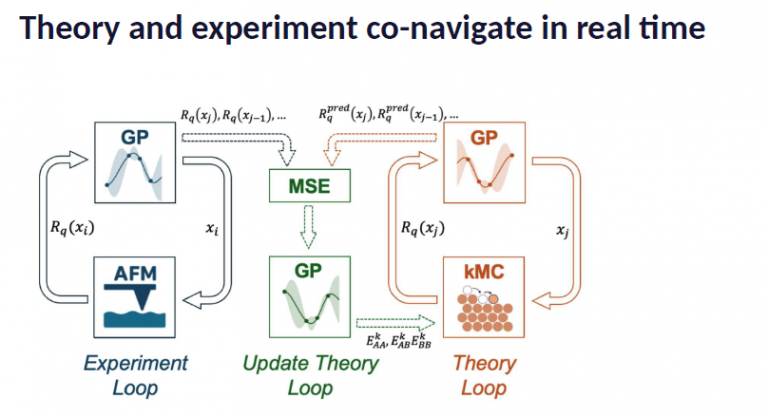
AlphaFilm combines physics-based and AI-based simulation with two key experimental capabilities: National Lab of the Rockies' combinatorial co-sputtering deposition, which can vary film thickness and composition across a single wafer, and the University of Tennessee, Knoxville's automated, multimodal scanning probe microscopy for fast characterization. Our role is to tie it together — we're developing an AI surrogate model, built on top of the underlying physics model, that factors in variables like temperature, density, roughness, ferroelectric response, and oxygen concentration to predict outcomes far faster than physics-based simulation alone, then feeding that back into an experimental loop with AI agents deciding what to try next. Our goal is defect-free pathways toward manufacturing these materials at scale.
Mat3ra's Sergey Barabash is the principal investigator on AlphaFilm, which carries a $750,000 grant covering nine months of work. The team also includes Professor Sergei Kalinin from UT Knoxville and Andriy Zakutayev from National Lab of the Rockies, with an unnamed defense contractor and chip company also involved as collaborators. We're now pursuing a Phase II Genesis Mission grant to continue the work.
AlphaFilm is one of three Phase 1 Genesis Mission projects we're contributing to this round:
Source: Woodie, A. (2026, September 14). Genesis Mission Project Uses AI to Speed Thin Film Development. HPCwire. Read the original article
Tags: AlphaFilm, Genesis Mission, Thin Film Discovery, Department of Energy, Timur Bazhirov, Sergey Barabash

Exabyte Inc.
1212 Broadway Plaza, Ste #2100 Walnut Creek, CA 94596
+1 (510) 473 7770
info@mat3ra.com
Mat3ra Japan K.K.
Otemachi Building 6F Inspired Lab,
1-6-1, Otemachi, Chiyoda-ku, Tokyo 100-0004 Japan


